"Disorder" Is Not A Mix-up At McDonald's
 |
| Leggo my... Chikkin sammich? |
Okay, so as a psych therapist in training, I am a little upset with how some people--some mainstream psychologists included--seem to reduce people to their diagnosis. "Oh, he has prosopagnosia." "I have this friend, he is autistic."
Now, to some extent, this can tell me a little something about a person, but there is so much more to a person than that. Each person adjusts differently to their own "stuff" and no two people are alike, regardless of the fact that they are both bipolar, or autistic, or borderline, or whatever!
Everybody Is At Least A Little Crazy

Thing is, that can be any of us. In my second year as a psych major, I took an class on personality theory. I thought it was weird that I would be taking a class on personality was a prerequisite for so many clinical psych classes. It took me a long time to realize why. Personality is not just "You are a blue, you are a yellow," (and by the way, people can score a different color depending on their mood, that is not really a great test for anything but taking for fun.) Personalities are 'disorders,' even if only mini ones. If you have a personality, you have a disorder.
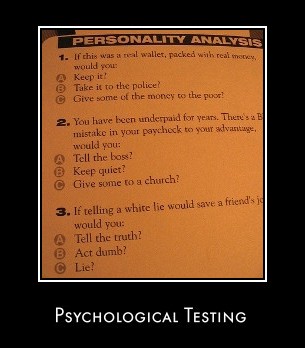 |
| The questions have tons of different sections; the questions get more complex, but this is a basic example. |
...Say What?
Psychologists give people intensive tests (that usually take several hours,) to help them know how those people think, how they feel in different situations. Psychologists don't rely strictly on those, and usually use at least two tests, interview the person face-to-face, and talk to many people that know this person in real life before making a decision. Two of the major tests are the Minnesota Multiphasic Personality Inventory (MMPI) and the Personality Assessment Inventory (PAI). Notice they both say "personality"? To psychologists, depression is a feature of personality. So is paranoia. So are hallucinations. So are obsessions, compulsions, tendencies, and your pattern of moods.
In these tests, of you score in the middle, you are 'normal.' Score at the edges, and it is a disorder. For example, you are upbeat and outgoing. This is a personality trait. Now, let's say that you are so outgoing that you are dependent on approval of others, and are desperate for their attention. This is a disorder called Histrionic Personality Disorder. You are low-key and keep to yourself. This is a personality trait. Or, you are so much of a loner that you really don't care for interacting with other people at all, not just strangers, anybody. You have no close friends, not even in your family, and you don't care. This is Schizoid Personality Disorder. Same with cheerful vs. manic; subdued vs. depressed.
It's Not Normal To Be "Normal"
Really, psychology is about stats; finding out through testing what most people are like, so we know what 'normal' is. The problem is that the person who scores a perfect 'normal' on every section of the tests does not exist. You will probably score a normal in many parts, but nobody is a perfect "normal." This is something we all know on some level, and most of us feel at least a little crazy sometimes, but rarely do we ever think "my personality shows that I am slightly histrionic, and a little schizophrenic." Usually, it's not enough to cause big enough problems to be important, or we figure out ways to cope. Sometimes the problem is so big that it needs treatment of some kind, or so unique that we need help figuring out some way to cope. Now when exactly does it stop being a "trait" and start being a disorder? At the score that the people who make the test say it should. It is a straight line, and if you are being tested for bipolar, and the disorder is "80 or higher", and you score a "79," then you aren't bipolar. Most psychologists would call it "borderline bipolar" and still recommend treatment, but the point is this:
Having an extreme personality trait means that the unique workings of your can make life hard sometimes. Having a much smaller trait doesn't mean that you don't have those problems, you just have them less. To have a personality is to have a mini-disorder, and can make life tough sometimes. Just realize that as you walk through life, you do not see things with a perfectly healthy brain, and neither does anybody else. Cut them and yourself a little slack!
Can't Have Your Cake And Eat It Too.
So a lot of the time, the very things we love about a person are the same things that can drive us nuts. Almost every personality trait and disorder has an upside and a downside. You have this friend who is hilarious and exciting to be around? Most likely being around them too long is really tiring, maybe even annoying. There is a person who is really chill, and doesn't seem to demand anything from you, or judge you? They probably aren't the first person you rush to with exciting news; it's also possible that when you are in a crisis and need someone, they will not want you to expect things from them. Love an actor because of how amazing they are at acting? Their vast versatility of emotions might be because their "emotional thermometer" is broken, and they are constantly feeling extremes of emotion, so they might be super dramatic in real life. Many bipolar people find amazing creativity in the mix of their up-and-down; autism comes with unparalleled focus, which can lead to being a genius in their selected field (although it can be hard for them to focus at will.)
Case in point: high IQ and mental disorder go hand-in-hand. A very high percentage of people who are listed as "geniuses" that are also listed as mentally ill. Reason? They think in a way that others do not. They have very unique minds. That's why they think of things that other people can't. You can't have that and expect it not to conflict with the way other peoples' minds work! There are always exceptions, but basically, the more different a person is, the more difference they can make in society, and the more likely they are to have a very extraordinary life, good and bad.
Yet we go around expecting other people to be perfect, yet be understanding of our own imperfections. That boy that bags the groceries had better be polite, no matter what is going on inside him. My family had better understand that I had a hard day, no matter what happened in their day. My boss had better be understanding when I am late, but I should never have to miss a vacation day because he forgot to file it!
Just ease up and realize that we are all amazing at being our very own unique us and that means we are all sick. Deal with the crap of others as you hope they deal with yours. We're all only human. Be humane.