In the meantime, here's a video of me presenting at a fantasy/sci-fi writer's conference about using neuropsych in fiction writing.
Monday, February 22, 2016
So...Here's a thing I did.
Sorry I haven't been writing so much lately. I needed to figure out a more constructive, informative, and entertaining way to do this. So I may have figured that out. Stay tuned.
In the meantime, here's a video of me presenting at a fantasy/sci-fi writer's conference about using neuropsych in fiction writing.
In the meantime, here's a video of me presenting at a fantasy/sci-fi writer's conference about using neuropsych in fiction writing.

Tuesday, September 10, 2013
If You Have A Personality, You Have A "Disorder"
"Disorder" Is Not A Mix-up At McDonald's
 |
| Leggo my... Chikkin sammich? |
Okay, so as a psych therapist in training, I am a little upset with how some people--some mainstream psychologists included--seem to reduce people to their diagnosis. "Oh, he has prosopagnosia." "I have this friend, he is autistic."
Now, to some extent, this can tell me a little something about a person, but there is so much more to a person than that. Each person adjusts differently to their own "stuff" and no two people are alike, regardless of the fact that they are both bipolar, or autistic, or borderline, or whatever!
Everybody Is At Least A Little Crazy

Thing is, that can be any of us. In my second year as a psych major, I took an class on personality theory. I thought it was weird that I would be taking a class on personality was a prerequisite for so many clinical psych classes. It took me a long time to realize why. Personality is not just "You are a blue, you are a yellow," (and by the way, people can score a different color depending on their mood, that is not really a great test for anything but taking for fun.) Personalities are 'disorders,' even if only mini ones. If you have a personality, you have a disorder.
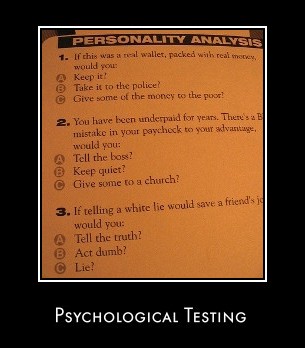 |
| The questions have tons of different sections; the questions get more complex, but this is a basic example. |
...Say What?
Psychologists give people intensive tests (that usually take several hours,) to help them know how those people think, how they feel in different situations. Psychologists don't rely strictly on those, and usually use at least two tests, interview the person face-to-face, and talk to many people that know this person in real life before making a decision. Two of the major tests are the Minnesota Multiphasic Personality Inventory (MMPI) and the Personality Assessment Inventory (PAI). Notice they both say "personality"? To psychologists, depression is a feature of personality. So is paranoia. So are hallucinations. So are obsessions, compulsions, tendencies, and your pattern of moods.
In these tests, of you score in the middle, you are 'normal.' Score at the edges, and it is a disorder. For example, you are upbeat and outgoing. This is a personality trait. Now, let's say that you are so outgoing that you are dependent on approval of others, and are desperate for their attention. This is a disorder called Histrionic Personality Disorder. You are low-key and keep to yourself. This is a personality trait. Or, you are so much of a loner that you really don't care for interacting with other people at all, not just strangers, anybody. You have no close friends, not even in your family, and you don't care. This is Schizoid Personality Disorder. Same with cheerful vs. manic; subdued vs. depressed.
It's Not Normal To Be "Normal"
Really, psychology is about stats; finding out through testing what most people are like, so we know what 'normal' is. The problem is that the person who scores a perfect 'normal' on every section of the tests does not exist. You will probably score a normal in many parts, but nobody is a perfect "normal." This is something we all know on some level, and most of us feel at least a little crazy sometimes, but rarely do we ever think "my personality shows that I am slightly histrionic, and a little schizophrenic." Usually, it's not enough to cause big enough problems to be important, or we figure out ways to cope. Sometimes the problem is so big that it needs treatment of some kind, or so unique that we need help figuring out some way to cope. Now when exactly does it stop being a "trait" and start being a disorder? At the score that the people who make the test say it should. It is a straight line, and if you are being tested for bipolar, and the disorder is "80 or higher", and you score a "79," then you aren't bipolar. Most psychologists would call it "borderline bipolar" and still recommend treatment, but the point is this:
Having an extreme personality trait means that the unique workings of your can make life hard sometimes. Having a much smaller trait doesn't mean that you don't have those problems, you just have them less. To have a personality is to have a mini-disorder, and can make life tough sometimes. Just realize that as you walk through life, you do not see things with a perfectly healthy brain, and neither does anybody else. Cut them and yourself a little slack!
Can't Have Your Cake And Eat It Too.
So a lot of the time, the very things we love about a person are the same things that can drive us nuts. Almost every personality trait and disorder has an upside and a downside. You have this friend who is hilarious and exciting to be around? Most likely being around them too long is really tiring, maybe even annoying. There is a person who is really chill, and doesn't seem to demand anything from you, or judge you? They probably aren't the first person you rush to with exciting news; it's also possible that when you are in a crisis and need someone, they will not want you to expect things from them. Love an actor because of how amazing they are at acting? Their vast versatility of emotions might be because their "emotional thermometer" is broken, and they are constantly feeling extremes of emotion, so they might be super dramatic in real life. Many bipolar people find amazing creativity in the mix of their up-and-down; autism comes with unparalleled focus, which can lead to being a genius in their selected field (although it can be hard for them to focus at will.)
Case in point: high IQ and mental disorder go hand-in-hand. A very high percentage of people who are listed as "geniuses" that are also listed as mentally ill. Reason? They think in a way that others do not. They have very unique minds. That's why they think of things that other people can't. You can't have that and expect it not to conflict with the way other peoples' minds work! There are always exceptions, but basically, the more different a person is, the more difference they can make in society, and the more likely they are to have a very extraordinary life, good and bad.
Yet we go around expecting other people to be perfect, yet be understanding of our own imperfections. That boy that bags the groceries had better be polite, no matter what is going on inside him. My family had better understand that I had a hard day, no matter what happened in their day. My boss had better be understanding when I am late, but I should never have to miss a vacation day because he forgot to file it!
Just ease up and realize that we are all amazing at being our very own unique us and that means we are all sick. Deal with the crap of others as you hope they deal with yours. We're all only human. Be humane.
Monday, September 2, 2013
Happiness Abuse: How Brainzes Work (How To Be Happy Without Even Trying Part II)
Too Much Of A Good Thing
 |
| They told me I could be anything when I grew up. I wanted to be a balloon animal. |
So this guy over here is pretty excited about the post today. I'm sure you all are too, but the real reason I posted him is that muscles are sexy. Now, ladies, show of hands, who thinks this much muscle is sexy? Usually there are a few that think so, but good grief, can he even touch his head? Also, are those veins or parasite worms from some sci-fi horror movie? Most people are kind of put off when the muscles get too amazing. You know, like slender is attractive vs. anorexic is worrying and makes us feel sad. Too much of pretty much anything good will eventually be bad. There are exceptions, of course. You know, like bacon. And you can never have too much cowbell.

Da Neuron
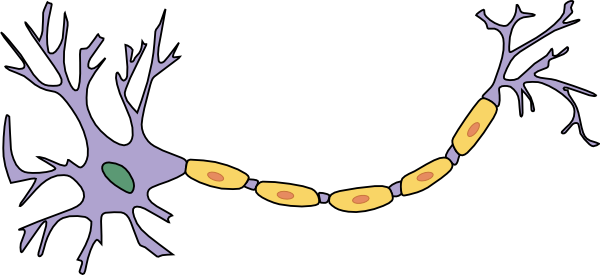 |
| You know, if a centipede and a fried egg had a baby I think this is what it would look like. |
 |
| That is your brain. I know, right? It should totally look more like grey jello. |
No Touchy!
So if we were to take a close look at the part where those tentacles connect to other neurons, we will notice that they don't actually touch. When a brain cell sends a signal, little tiny chemical dots are released from the tips of those bitty tentacles , and float around in your brain juice until they wander into specially-shaped sensor thingies on the other side. One brain cell can play tons of different roles, send tons of different messages; pain, happiness, hunger, relaxation, the taste of pizza, whatever. Our simplified version of a brain cells sending messages looks like this: (I only include 3 here, and there are really hundreds, but I figgered we should follow the K.I.S.S. method. "Keep It Simple, Stupid!") |
| I maked it mahselfs. Go easy on me. |

Balance Restored!
...Geez, balance sucks.
Our bodies, being the amazing things they are, keep things balanced. We have a gazillion little thermostats for everything; salt, temperature, sugar, different kinds of blood cells, all that jazz. This is a good thing; well, at least, it keeps us alive, if you like that sort of thing. I do, and I figure if you are alive and reading this blog, it means you are probably keen on living too.
 Anyway, we have a thermostat for these little brain cell messages too. See, if you trigger the same brain-cell-message over and over and over all the time, it burns that baby out, and that brain cell dies. (Which, by the way, is one of the theories of how rabies kills people. It makes your brain cells keep signalling until they die.) That's kind of a bad thing, so your brain retracts some of those happiness sensors on the receiving end. One receiver can't read as fast as many receivers, so "happy" is toned down to normal levels. You actually become a little immune to happiness. It looks (sorta) like this:

So with your new happiness immunity; with tons of these "happy" messages being sent and only a few being read, you feel normal amount of happy. You need more to make you happy. Now what happens when you meet a little bit of sad in your life? Or you run out of drugs? Or you have to leave the beach? Or BYU loses? Less of the happy chemicals are sent, and it might bring you to normal chemical levels, but you have so few sensors that it feels... Well, like I did the day they cancelled "Firefly."

We often talk about how humans are so versatile that we can train ourselves adapt to anything. Happiness is no exception. Even if sitting on the beach all day doesn't make you as high on happy as taking Charlie Sheen-like piles of drugs, you still get used to it. The novelty wears off. You adapt.
Happy Iz All Gone?

Variety. Sadness, pain, anxiety, stress, disappointment, sorrow. Sorry to say it, but all these things can help you be more sensitive to the happiness. I'm not saying you should all go out and be masochists. I'm also not saying that just feeling a bit of sadness or pain will fix the immunity to happiness all by itself. It takes practice to accept these "bad" emotions (but are they really bad?) as an unavoidable and necessary fact of life, and make emotions be something that happens to you, rather than thinking that feelings are you and letting them take over.
Think of it this way. The hungrier you are, the better the food tastes. The more weary and worn out you are, the better that soft bed feels. Emotions are much the same. We were not built with just one setting, and that is for a reason. This is why I think it's silly that we try to keep ourselves permanently set on "blissful." We are built to thrive in a beautifully broad spectrum of emotions; light, dark, soothing, vibrant, and everything in between. One emotion, experienced by itself for a lifetime, loses all meaning; so does the life that it dominates. One color makes for a boring painting. Our lives are rich murals.
Happiness is like a cat; the best way to get close to it is to stop chasing it relentlessly, and let it come to you when it feels like it. Let your life center on what is meaningful and fulfilling, not what is pleasurable. Let yourself figure out why "bittersweet" is often an oddly pleasant and satisfying thing.
Out of curiosity, have any of you experienced any of this? Let me know your story! Leave me a comment. Even if you just disagree with me and want to say so, that's fine. So does Freud. I'd love to hear your points, and I promise not to treat you like a troll. Hearing objections can only teach me more.


So with your new happiness immunity; with tons of these "happy" messages being sent and only a few being read, you feel normal amount of happy. You need more to make you happy. Now what happens when you meet a little bit of sad in your life? Or you run out of drugs? Or you have to leave the beach? Or BYU loses? Less of the happy chemicals are sent, and it might bring you to normal chemical levels, but you have so few sensors that it feels... Well, like I did the day they cancelled "Firefly."
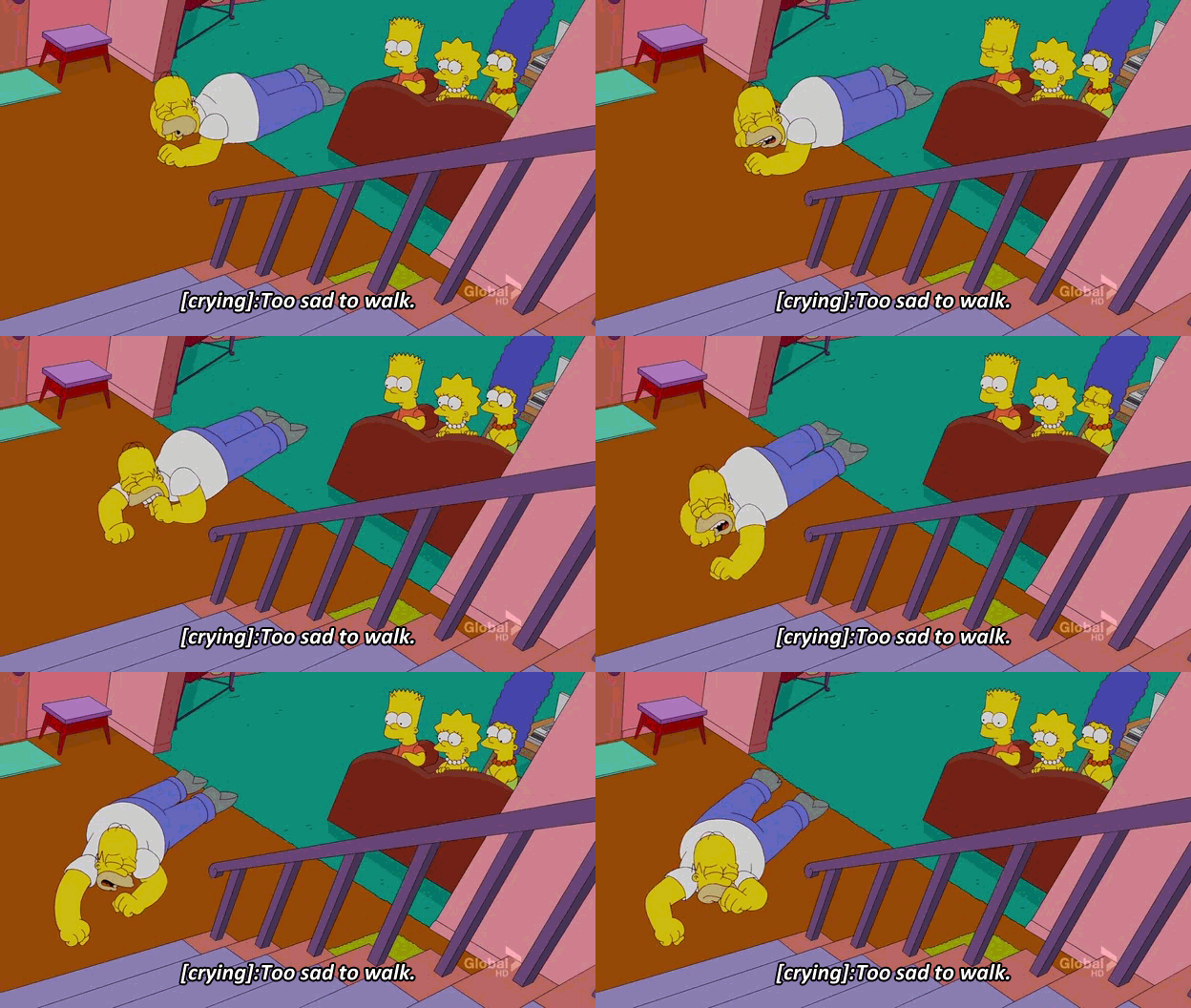
We often talk about how humans are so versatile that we can train ourselves adapt to anything. Happiness is no exception. Even if sitting on the beach all day doesn't make you as high on happy as taking Charlie Sheen-like piles of drugs, you still get used to it. The novelty wears off. You adapt.
Disclaimers, Exceptions, Stipulations, Clarifications, And A Bag of Chips
This is all talking about the average person. There are many people who naturally have higher tolerance for "happy." As weird as it seems, that can be really bad. It's the upswing of bi-polar. They can get so lost in playing that they ignore the big important things like bills, jobs, family, and stuff like that. Sometimes they get so lost in the feeling that they don't stop to think about consequences. Some of them get addicted to things that make them feel the upper limits of their ability to feel happiness. For some, it means that they can't cope with a little sadness when it comes.
Then there are people who have a broken 'happiness thermostat' from birth (or a ton of other things,) and get toned down to a state of depression.
Also, keep in mind that this is just a super-simple version, just to get the general idea across without giving a full course in neuropsychology.
And the promised a bag of chips:

Okay, back to your regularly scheduled blog.
And the promised a bag of chips:

Okay, back to your regularly scheduled blog.
Happy Iz All Gone?
What Me Use For Happy Now?
Variety. Sadness, pain, anxiety, stress, disappointment, sorrow. Sorry to say it, but all these things can help you be more sensitive to the happiness. I'm not saying you should all go out and be masochists. I'm also not saying that just feeling a bit of sadness or pain will fix the immunity to happiness all by itself. It takes practice to accept these "bad" emotions (but are they really bad?) as an unavoidable and necessary fact of life, and make emotions be something that happens to you, rather than thinking that feelings are you and letting them take over.
Think of it this way. The hungrier you are, the better the food tastes. The more weary and worn out you are, the better that soft bed feels. Emotions are much the same. We were not built with just one setting, and that is for a reason. This is why I think it's silly that we try to keep ourselves permanently set on "blissful." We are built to thrive in a beautifully broad spectrum of emotions; light, dark, soothing, vibrant, and everything in between. One emotion, experienced by itself for a lifetime, loses all meaning; so does the life that it dominates. One color makes for a boring painting. Our lives are rich murals.
Happiness is like a cat; the best way to get close to it is to stop chasing it relentlessly, and let it come to you when it feels like it. Let your life center on what is meaningful and fulfilling, not what is pleasurable. Let yourself figure out why "bittersweet" is often an oddly pleasant and satisfying thing.
Out of curiosity, have any of you experienced any of this? Let me know your story! Leave me a comment. Even if you just disagree with me and want to say so, that's fine. So does Freud. I'd love to hear your points, and I promise not to treat you like a troll. Hearing objections can only teach me more.
Tuesday, August 27, 2013
How to Be Happy Without Even Trying: Part I
Don't Hold So Tight To 'Happiness'
In my last post, I said that seeking only personal happiness as a driving force in our lives didn't work, as least for marriage. I think it works that way for pretty much everything. I'm not saying that you should follow the advice of the bumper sticker "Since I gave up hope, I feel much better." Well, kinda, but not quite. What I am saying is that trying so hard to have only pleasure in life is like chasing a high on drugs. You can find it for a minute, but then is slips away, and you never get the same high from those same things again. Personal happiness is kind of like wet soap; the harder you hold onto it, the faster is slips out of your fingers.
What in the Name Of Materialism Do You Mean?
| Nice place to visit... But do you want to live here? |
That's the problem. We think this will make us happy because we think that hard work, responsibilities and difficulties are things we don't like. What if all you did every day was exactly what you felt like doing? Just relax. You want food? You can pay somebody to fix it for you. Don't feel like cleaning? That's okay, the maid will do it for you.
In reality, most of us would hate living that way for long. We get depressed. We get anxious. Think of those days that you sleep late, do nothing, talk to nobody, and realize right before bed that you are still in your pajamas, never showered, and your house is dirty because you haven't cleaned up after yourself. If you are anything like me, you feel filthy, bloated, smelly, and stagnant. Imagine that, year-round. Even if we shower, clean up, etc, if we actually spend all our time seeking pleasure, we feel that our life has no meaning.
Examples, please?
 |
| See how they are living the American dream? |

Dave Ramsey is a self-made millionaire who found out about money and happiness the hard way. He went bankrupt. He now tells people all he can about wealth; how to get it, and what it doesnot do. To paraphrase him, 'Money doesn't make you happy; it makes you more of what you are.' So he says that if you are a happy poor person, you will be a happy rich one. If you are an unsatisfied poor person, you will be an unsatisfied rich one.
Jack Dorsey (co-founder of Twitter and Square Up credit card readers,) makes this point particularly clear. In a podcast of a business lecture series at Stanford, he talks about how he was newly a millionaire, sailing around the world in his private yacht, and discovered that he was disgusted with his life as it was. So he came home and founded another company. He talked about how hard it is to found a business, no matter how much money you have, but how surprisingly that was what he wanted.
 In Your Face, Freud!

Viktor Frankl, a psychologist/neuroscientist who wrote one of my favorite books ever, "Man's Search for Meaning," was a Holocaust survivor. He wrote about his experiences, and what he learned about human nature while he was
there. In particular, he explained how cigarettes were craved by all the inmates, as most were addicted to tobacco, and so they were used as currency, to be saved and spent carefully. Nicotine eases anxiety. Frankl said that you could tell when a man had given up on life when he began to smoke his cigarettes. Now pay careful attention to what I just said. He claims that when a man began to actively try to escape the stress and pain of the camp, seeking the pleasure and relief of anxiety provided by his cigarettes, it was when he had lost the will to live. We survive if we have fight, if we are not afraid to accept pain, and if pleasure is not our driving force. (*cough*In your face, Freud!*cough*)
Now, Freud and Darwin tell us that seeking pleasure is what keeps us alive. What does Frankl find keeps us alive? He put it this way; "Those who have a 'why' to live, can bear with almost any 'how.'" He says the ones to live were those with a meaning greater than themselves to live for. A son, a wife, or in Frankl's case, a life's work in the field of human mental health to publish. Those were the ones that lived. Not the ones that sought only for their own comfort and to avoid their own pain. Darwin calls for survival of the fittest, and apparently the fittest think in a bigger picture than the one they see in their mirror.
 |
| If this is your reason to live, your odds of surviving Auschwitz just dropped. |
So What is a 'Meaning' to Live For?
That is an excellent question. Going back to Frankl, "Ultimately, man should not ask what the meaning of his life is, but rather he must recognize that it is he who is asked." I think that this is a discovery that takes a lifetime. I think that Maslow had some ideas, about becoming our best self, fulfilling our potential, or as he called it 'self-actualization,' but I think that his concepts are a little too inward-focused.I'm sure my answer as to what makes a life meaningful will never be complete until my life is over, so in the meantime I'll just a list few key points that I've found so far:
- Challenges: In every movie, every book, every captivating work of fiction, there is a problem. There is conflict. Without that, why would we care? We are intrigued by it. When we have leisure time (when we aren't busy facing our own conflicts,) we entertain ourselves by reading of conflict elsewhere. The more dire the circumstance, the more exciting the story. I think it is the same in our own lives. If we aren't challenged; if everything is easy, we feel that there is a lot of meaning missing in our lives.
- Progress: I think this is what challenges give us; growth. The excitement of a child at learning to walk, or a chemistry student learning to make his mixture change color, or even the bodybuilder breaking his previous record. We want to be more today than we were yesterday.
- Connection to other people: This is so many-fold that you will have to imagine most of it. Sometimes this is family and loved ones. Sometimes, like in Frankl's case with his research, it is all mankind. In whatever way, we feel worthwhile when we are sacrificing anything (time, effort, money, even just thoughts,) to others. In the concentration camps, it was easier for people to forget their own hunger when working hard to satisfy the hunger of others. This is why my contradictory advice to many unhappy people is, "forget about trying to fix your own problems; go help somebody else fix theirs." It's amazing how well it works.
Most of the songs, stories and poems we find especially beautiful, touching, or meaningful fit in these categories. The movie "Life is Beautiful" which is a story full of funny and joy, but also very full of sorrow and strife. Or the poem "Invictus" by William Ernest Henley.

So really, my opinion is that you don't care nearly as much as you think you do about living a life that is carefree and free from want. I think you care far more about living life so as to feel that you are a worthwhile human being that makes the world a better place. And the best way to do that is to forget about you.
Ultimately, I believe that a life is best lived when it is given to others. So how do you be happy? Stop trying to look for it so hard for yourself, and you'll be surprised to find the nobility in minor day-to-day struggles and sacrifices for others. Don't keep score, imagine that you have an infinite obligation to the people around you, and you'll stop caring as much what you have or don't have, what goes wrong in your life. Get out of your head and over yourself. There are over 6,000,000,000 other people on the planet. Go make a difference to more than just the one that is reading this blog.
and What is the Comparison to Drugs?
Yeah, that is comparison to drugs is completely literal. (Well blast me to next birthday, I'll have to finish this tomorrow... My brain goes to bed at the same time no matter when my body does.)
Friday, August 23, 2013
Darwin and Divorce.
Put Two Monkey Traits on Low Heat, Stir Occasionally.
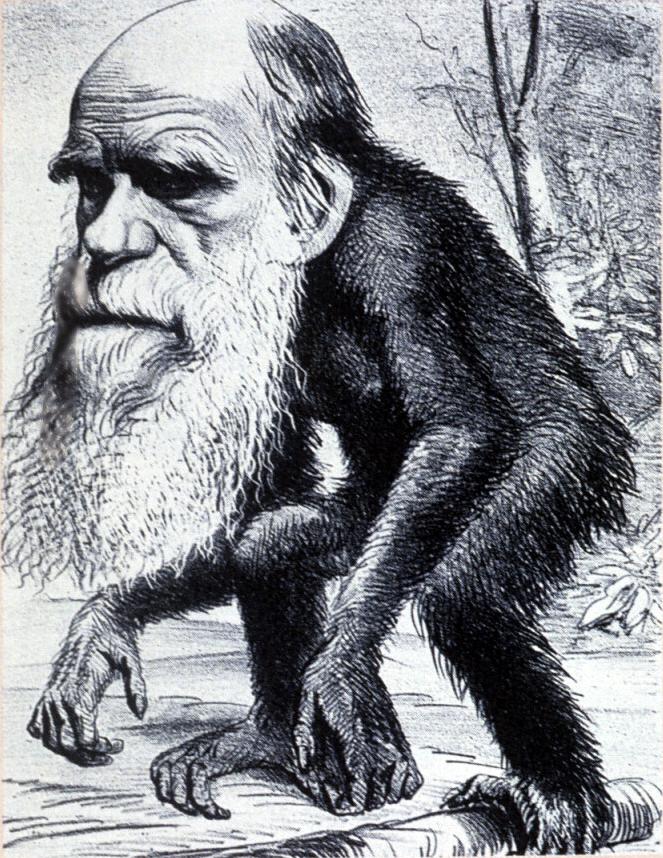
So this guy here is Darwin. Now, I'm just a little ancy right now, because I can feel the militant Darwinists and Anti-Darwinists (Darwinians? Darwinese?) both waiting to attack as soon as I say anything. Easy now, fellas. I ain't lookin' for trouble. I'm not going to say whether we came from monkeys or no. I'm just going to talk about how he ruins marriages. Yep. Thasswright. See, Darwin said that the only creature that would survive were ones with certain traits, and they passed on those traits to their little baby creatures. Say, all the animals that like to eat live, and the ones that hate eating, die. Freud loved these concepts, and said, "Yes! That is why we find pleasure in eating, and experience the pain of hunger when we don't!" And thus the Pleasure Principle was born. Most psychologists believe that most of what we do can be 100% explained by our evolutionary desire to feel good and not feel pain.
 Sprinkle in Powdered-wig Philosophers

Locke hated the idea that we needed a guy to bash us over the head to make us get along. He figured we all would do it voluntarily once we saw how much it helped us individually be safe and helped us stay free to follow our dreams.
So what? Why the old dead philosopher's disagreement? Well, no matter which one you pick, you obey the government so you can get what you want. Same with Adam Smith's work,which would later play a big role in the creation of American Capitalism; you work to get more stuff for you, and that='good.' Same with most religions; you follow these rules to get what you want from God. Did you catch that? They way we think about religion, political philosophy, science, psychology, it all tells us that the way to be happy is to seek pleasure for yourself.
Drizzle Over Children, Marinate for Centuries
 So here we are, centuries later, having been taught all these things for years and years. My guess is that most of us recoil at the idea that Americans believe that we are only supposed to do things that serve us selfishly. We don't like to think of ourselves that way. Yet what is the "American Dream?" May I suggest that it looks like this:
We dream of being able to satisfy all our own desires, and gain as much power as we can. We idolize people who have enough money that they don't need to do anything. We teach our businessmen to force suppliers and employees to accept as little payment as possible, and force customers to pay as much as possible for the same thing; not to try to help everybody get the best deal out of the whole arrangement.
We are taught of Darwin in elementary school, Locke and Hobbes in history, blessings and punishments at church, and commissions and bottom lines at work. Everywhere, we are told that 'good' means ease for me, comfort for me, satisfied appetites for me, and that is why we work, eat, marry, go to church. We do everything we do so that we can 'feel good.' The underlying assumption from all these lessons is that if it is hard, or painful, or doesn't serve me, then it is not 'right.'
We are taught of Darwin in elementary school, Locke and Hobbes in history, blessings and punishments at church, and commissions and bottom lines at work. Everywhere, we are told that 'good' means ease for me, comfort for me, satisfied appetites for me, and that is why we work, eat, marry, go to church. We do everything we do so that we can 'feel good.' The underlying assumption from all these lessons is that if it is hard, or painful, or doesn't serve me, then it is not 'right.'

Add A Little Disclaimer, Season to Taste...
Now, I am a capitalist. I think that Darwin was right about many things, and can see many evidences of evolution. I am a Christian, and believe that it brings me happiness. I actually really like both Hobbes and Locke, and tons of other philosophers. Freud, well, okay, I don't like him very much. I believe that business is not evil, and neither is wealth and profit. I say that personal ambition is a good thing. I just believe that these things only work right when we have a larger picture than "me." I mean, they do inspire hard work, creativity, many other good things. I believe that most of us are good people, and care about others around us. Yet when many of us stop and think about the big things in our lives, we think almost entirely, "is this working for me?" I think we give too much weight to "is this working for me?" rather than "is this working?"
Dissolve Marriage in the Mixture, and Serve. Makes 2,000,000 Annually.
Okay, you all see this punch coming. So these founding American principles get misapplied in marriage. Marriage is not and cannot be about the "me." That kind of self-focus kills marriages. Here is a list of Top 10 reasons for divorce:
1. Lack of communication.
2. Finances.
3. Feeling constrained.
4. Trust.
5. Expectations from each other.
6. Your spouse doesn't understand / fulfill your needs and desires.
7. Quick change in lifestyle.
8. Insecurity.
9. Religious and cultural differences.
10. Abuse.
What a list of ME, ME, ME. Not all of these are always caused be selfishness alone, but there are elements of it in almost every one of these. Here's the subtext:
1. Lack of communication. Sometimes this means they don't know how to communicate, but usually one or both partners just become less invested in the other; less focused on finding out what the other person thinks or feels, more on self. We seek to be understood, not seek to understand. "I'm sorry, I can't hear you over all the things I want to say."

3. Feeling constrained. In other words, "I don't get to do the things I want." I hate the nickname "ball-and-chain," even as a joke. Your spouse is your teammate. Sometimes this feeling of being limited by your spouse is real; there are some truly controlling people in the world (you know, ones interested only in self?) but I think there are a lot of molehills made into mountains by people who don't get that working relationships mean sacrifice.
4. Trust. When you can't trust the other partner to keep both of your best interests in mind, instead of acting selfishly.
5. Expectations from each other. Expectations of stuff you should do for me.
6. Your spouse doesn't understand / fulfill your needs and desires. This is the big one. Do I really need to say more? "You aren't serving my happiness."
7. Quick change in lifestyle. Here, the explanation from the website is all I need. "Couples that can’t compromise and meet in the middle are unable to adapt to new changes and be together in harmony." (Italics added.)
8. Insecurity. When one partner is selfish, the other will often not feel that the relationship is stable. Same thing if one partner has an unrealistic idea of what the other is supposed to give.
9. Religious and cultural differences. Okay, this one is different, and complex. Some of them are moral standpoints, others can seem that way. Still, some of it can be unwillingness to compromise for selfish reasons.
10. Abuse. Abuse is one person trying to get what they want out of the other at the expense of the other. Pure and simple.
There you have it. We are taught that, by nature, we are alive and survive to seek pleasure; our own needs. All that we do is to serve that as the greatest good. What are the ways we say "I love you"? I need you. You make me happy. You are everything I ever wanted. Most chick flicks have lines of a guy pleading a girl to take him back because "Since you left, I've cried every night, food has no taste;" ....So please come back to end my pain and make me happy. We have selfish reasons to love hidden in our cliche lines of love; the one thing that is supposed to be selfless. Given this education in love and right and wrong, is it any wonder we have trouble seeing reasons to stay in marriage when the going gets tough? That's my theory, anyhow. Tons of other factors, but I think this is the bottom line. My voice is one in the millions on this issue; take or leave it.
So then you must ask... If not for our happiness, why? If we don't follow religion, get married, get a job, work for happiness or for our own good... Why? Should we seek pain and misery, or what? Tune in tomorrow and find out. Well, maybe not tomorrow. I think I might give serious stuff a rest until next week. We'll see how I feel tomorrow.
There you have it. We are taught that, by nature, we are alive and survive to seek pleasure; our own needs. All that we do is to serve that as the greatest good. What are the ways we say "I love you"? I need you. You make me happy. You are everything I ever wanted. Most chick flicks have lines of a guy pleading a girl to take him back because "Since you left, I've cried every night, food has no taste;" ....So please come back to end my pain and make me happy. We have selfish reasons to love hidden in our cliche lines of love; the one thing that is supposed to be selfless. Given this education in love and right and wrong, is it any wonder we have trouble seeing reasons to stay in marriage when the going gets tough? That's my theory, anyhow. Tons of other factors, but I think this is the bottom line. My voice is one in the millions on this issue; take or leave it.
So then you must ask... If not for our happiness, why? If we don't follow religion, get married, get a job, work for happiness or for our own good... Why? Should we seek pain and misery, or what? Tune in tomorrow and find out. Well, maybe not tomorrow. I think I might give serious stuff a rest until next week. We'll see how I feel tomorrow.
Thursday, August 22, 2013
What, for the love of all that is ridiculous, is this blog about?
Happy Thursday!
...Okay, fine, how would you have started this post?
So.... I have given very few clues as to what this blog will be about. I will try fill you in without being boring. I am a guy who has way to many interests to be considered healthy. This will be a conversational blog about interesting facts about all of them. Brains, fiction books, the science of the human body, religion, how to have a happy life, economics, human nature...
I spend a lot of time studying the human brain, and the ways we use it. I'm studying to be a psychological therapist, and study a lot of neuroscience. So basically....
I spend a lot of time studying the human brain, and the ways we use it. I'm studying to be a psychological therapist, and study a lot of neuroscience. So basically....
This is your brain:

And this your brain on my blog:

I plan disect the human brain and psyche for us all to have a poke around. Keep your shirt on... I just mean I'll post a lot about what I have learned, where I think mainstream psychology gets a bit full of itself, (*coughFREUDcough*) and a few theories. (Picture the universe as a giant brain...) I also like to put them in perspective by seeing how modern psychological theory affects and even changes all of us, even when we don't notice it; in religion, work, the grocery store, you name it.

I read stuff and I write stuff.
I love fiction. I think they often have amazing points, and can teach us about ourselves and the way we see the world. I read all kinds of things, but my escape is fantasy and science fiction novels. I write some of my own; mixing in neuroscience, quirkiness, a sprinkle of redhead, and stir to a simmer.
I'll post some examples, as long as you promise to tell me exactly what you think. And as long as you guys aren't totally against my retelling of Cinderella as a sci-fi covert agent, the 3 little pigs as a western, and Rapunzel as a psychiatric patient. (Oh, and in case the picture isn't clear.... I'm holding a ring...)

I do the 'making of stuffs' thing
I like to make stuff in real life. My wife is a huge Dr. Who fan (even more so than me,) so I made her these TARDIS earrings for her birthday. Yes, it took a long time. And yes, I am pretty much the best husband ever.
I am working on turning an old piano into a computer desk. Expect at least a few posts about crazy ideas that I am excited about!

I Actually Have a Job.
(I Know, Who'd have thunk?)
I'm a piano professional piano technician. This means I tune them and I fix them, and I love them, and I am a horrendous piano snob. (That's me with the guts of a grand piano, making it all better.) Won't make me rich, but I love it, and will still probably keep it up on the side even after I get licensed as a psych therapist. I won't write much about this directly, (I'll save that for www.pianotunerman.com,) but it taught me a lot about work, business, marketing, and people.

I'm all Growed Up With Kids 'n Stuff
Most important of all, I am a happily married husband of 6 years (as of last week,) and the proud father of two shoulder angels. Well, one at least, depending on the day, and whether or not they have decided to give my laptop a "bath." Yeah, don't ask.
Still, laptop baths included, I'm glad I'm a daddy, and nauseatingly glad I married my wife. I promise, this blog won't be just a brag-fest or a glorified love-letter, but I'll put in all the things that my psychology studies, my parents, my own thoughts, and experience has taught me about some really amazing secrets to dealing with the hard parts. Like how I partly blame the way we teach about Charles Darwin for the rise of the divorce rate in the USA.
Stay tuned, stay sexy, and sign in tomorrow to figger out what the devil I mean by such ridiculous claim.
Wednesday, August 21, 2013
Quintessential Paradigm of Absurdity
Welcome to the Dork Side
Take your Cursor! Strike me down! And your journey to the--aww skip it. Welcome to mah blog, snitches.
 <This is me.
Well, the dude is. I am not boths of us. I am wanted in 5 countries, banned from 3 more, legendary in 42 states, was declared an illegal substance in Texas, and killed a bear by flexing my nostrils. My DNA is the international reference for the color red, I snore in sonnets mistakenly attributed to Shakespeare, and when Sotheby's had my used kleenex up for auction, the resulting riot lasted for two weeks.
I invented Mount Everest, Pokemon, and the color puce, am immune to embarrassment and most forms of pastry, explored the depths of the universe before lunch. My fingers have built coliseums, pyramids, a toothpick model of Napoleon, and picked more than a few noses. My snot is used as fuel for warp drives, and my spit can cure cancer and depression, and my tears have been declared weapons of mass destruction. Superman decided to wear red only after he saw my hair, and stole my nick-name for his super-ego (a little Dr. Freud joke there... If you got that, then you are pretentious. If you didn't get it, there may be hope for you,) I can swallow an alligator and spit out a designer purse with a zipper made of diamonds.
Just my name is so poetic and musical that it spent a month at the #1 spot in the billboard charts, and is a constant New York Times Bestseller. I am Danny Potter. Honest.
And yes, I know. I use some... strong language.
Not e'erbody can handle it. So if you can't handle words like "Freakin," and "schpuntz," and "poopy," and "omiholyfreakinmotherofeddison," then you best be done, son. 'Cause I am not afraid to get real.
Also, I wrote this today (deep, I know. I even surprised myself,):
"I don't mind talking to myself. Honestly, I don't even mind getting into arguments with myself. It's just that sometimes I get so bull-headed and a bit too heated, and then I say something really hurtful to me, and storm off in a huff. (I'm all like "Whhhhhuuuuut?" Ref picture at right,) Then I go through the whole ordeal of trying to make it up to me. It's hard, because at first I'm refusing to talk to me, but what worthwhile relationship is doesn't take a little work?


So I buy me flowers, and leave little surprise love notes for myself, and finally I win. Heck, I'm just so cute; I can't stay mad at me forever. The only real problem it presents is when I'm sitting in a crowded room, and I crack a joke to myself and break up laughing. Honestly, people look at me as if I were crazy."

And I don't get that.
I'm not crazy.
I mean, I can neither confirm nor deny that somebody may have given me caffeine.......
......But I'm pretty sure it didn't do anything anywa---look, something shiny!
Subscribe to:
Posts (Atom)