Too Much Of A Good Thing
 |
| They told me I could be anything when I grew up. I wanted to be a balloon animal. |
So this guy over here is pretty excited about the post today. I'm sure you all are too, but the real reason I posted him is that muscles are sexy. Now, ladies, show of hands, who thinks this much muscle is sexy? Usually there are a few that think so, but good grief, can he even touch his head? Also, are those veins or parasite worms from some sci-fi horror movie? Most people are kind of put off when the muscles get too amazing. You know, like slender is attractive vs. anorexic is worrying and makes us feel sad. Too much of pretty much anything good will eventually be bad. There are exceptions, of course. You know, like bacon. And you can never have too much cowbell.

Da Neuron
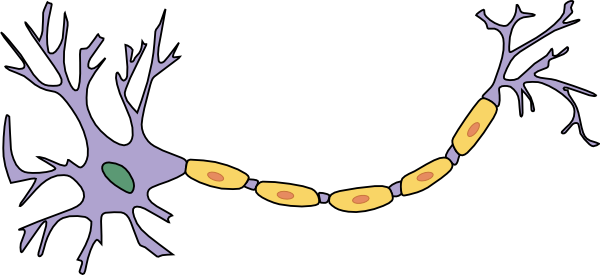 |
| You know, if a centipede and a fried egg had a baby I think this is what it would look like. |
 |
| That is your brain. I know, right? It should totally look more like grey jello. |
No Touchy!
So if we were to take a close look at the part where those tentacles connect to other neurons, we will notice that they don't actually touch. When a brain cell sends a signal, little tiny chemical dots are released from the tips of those bitty tentacles , and float around in your brain juice until they wander into specially-shaped sensor thingies on the other side. One brain cell can play tons of different roles, send tons of different messages; pain, happiness, hunger, relaxation, the taste of pizza, whatever. Our simplified version of a brain cells sending messages looks like this: (I only include 3 here, and there are really hundreds, but I figgered we should follow the K.I.S.S. method. "Keep It Simple, Stupid!") |
| I maked it mahselfs. Go easy on me. |

Balance Restored!
...Geez, balance sucks.
Our bodies, being the amazing things they are, keep things balanced. We have a gazillion little thermostats for everything; salt, temperature, sugar, different kinds of blood cells, all that jazz. This is a good thing; well, at least, it keeps us alive, if you like that sort of thing. I do, and I figure if you are alive and reading this blog, it means you are probably keen on living too.
 Anyway, we have a thermostat for these little brain cell messages too. See, if you trigger the same brain-cell-message over and over and over all the time, it burns that baby out, and that brain cell dies. (Which, by the way, is one of the theories of how rabies kills people. It makes your brain cells keep signalling until they die.) That's kind of a bad thing, so your brain retracts some of those happiness sensors on the receiving end. One receiver can't read as fast as many receivers, so "happy" is toned down to normal levels. You actually become a little immune to happiness. It looks (sorta) like this:

So with your new happiness immunity; with tons of these "happy" messages being sent and only a few being read, you feel normal amount of happy. You need more to make you happy. Now what happens when you meet a little bit of sad in your life? Or you run out of drugs? Or you have to leave the beach? Or BYU loses? Less of the happy chemicals are sent, and it might bring you to normal chemical levels, but you have so few sensors that it feels... Well, like I did the day they cancelled "Firefly."

We often talk about how humans are so versatile that we can train ourselves adapt to anything. Happiness is no exception. Even if sitting on the beach all day doesn't make you as high on happy as taking Charlie Sheen-like piles of drugs, you still get used to it. The novelty wears off. You adapt.
Happy Iz All Gone?

Variety. Sadness, pain, anxiety, stress, disappointment, sorrow. Sorry to say it, but all these things can help you be more sensitive to the happiness. I'm not saying you should all go out and be masochists. I'm also not saying that just feeling a bit of sadness or pain will fix the immunity to happiness all by itself. It takes practice to accept these "bad" emotions (but are they really bad?) as an unavoidable and necessary fact of life, and make emotions be something that happens to you, rather than thinking that feelings are you and letting them take over.
Think of it this way. The hungrier you are, the better the food tastes. The more weary and worn out you are, the better that soft bed feels. Emotions are much the same. We were not built with just one setting, and that is for a reason. This is why I think it's silly that we try to keep ourselves permanently set on "blissful." We are built to thrive in a beautifully broad spectrum of emotions; light, dark, soothing, vibrant, and everything in between. One emotion, experienced by itself for a lifetime, loses all meaning; so does the life that it dominates. One color makes for a boring painting. Our lives are rich murals.
Happiness is like a cat; the best way to get close to it is to stop chasing it relentlessly, and let it come to you when it feels like it. Let your life center on what is meaningful and fulfilling, not what is pleasurable. Let yourself figure out why "bittersweet" is often an oddly pleasant and satisfying thing.
Out of curiosity, have any of you experienced any of this? Let me know your story! Leave me a comment. Even if you just disagree with me and want to say so, that's fine. So does Freud. I'd love to hear your points, and I promise not to treat you like a troll. Hearing objections can only teach me more.


So with your new happiness immunity; with tons of these "happy" messages being sent and only a few being read, you feel normal amount of happy. You need more to make you happy. Now what happens when you meet a little bit of sad in your life? Or you run out of drugs? Or you have to leave the beach? Or BYU loses? Less of the happy chemicals are sent, and it might bring you to normal chemical levels, but you have so few sensors that it feels... Well, like I did the day they cancelled "Firefly."
We often talk about how humans are so versatile that we can train ourselves adapt to anything. Happiness is no exception. Even if sitting on the beach all day doesn't make you as high on happy as taking Charlie Sheen-like piles of drugs, you still get used to it. The novelty wears off. You adapt.
Disclaimers, Exceptions, Stipulations, Clarifications, And A Bag of Chips
This is all talking about the average person. There are many people who naturally have higher tolerance for "happy." As weird as it seems, that can be really bad. It's the upswing of bi-polar. They can get so lost in playing that they ignore the big important things like bills, jobs, family, and stuff like that. Sometimes they get so lost in the feeling that they don't stop to think about consequences. Some of them get addicted to things that make them feel the upper limits of their ability to feel happiness. For some, it means that they can't cope with a little sadness when it comes.
Then there are people who have a broken 'happiness thermostat' from birth (or a ton of other things,) and get toned down to a state of depression.
Also, keep in mind that this is just a super-simple version, just to get the general idea across without giving a full course in neuropsychology.
And the promised a bag of chips:

Okay, back to your regularly scheduled blog.
And the promised a bag of chips:

Okay, back to your regularly scheduled blog.
Happy Iz All Gone?
What Me Use For Happy Now?

Variety. Sadness, pain, anxiety, stress, disappointment, sorrow. Sorry to say it, but all these things can help you be more sensitive to the happiness. I'm not saying you should all go out and be masochists. I'm also not saying that just feeling a bit of sadness or pain will fix the immunity to happiness all by itself. It takes practice to accept these "bad" emotions (but are they really bad?) as an unavoidable and necessary fact of life, and make emotions be something that happens to you, rather than thinking that feelings are you and letting them take over.
Think of it this way. The hungrier you are, the better the food tastes. The more weary and worn out you are, the better that soft bed feels. Emotions are much the same. We were not built with just one setting, and that is for a reason. This is why I think it's silly that we try to keep ourselves permanently set on "blissful." We are built to thrive in a beautifully broad spectrum of emotions; light, dark, soothing, vibrant, and everything in between. One emotion, experienced by itself for a lifetime, loses all meaning; so does the life that it dominates. One color makes for a boring painting. Our lives are rich murals.
Happiness is like a cat; the best way to get close to it is to stop chasing it relentlessly, and let it come to you when it feels like it. Let your life center on what is meaningful and fulfilling, not what is pleasurable. Let yourself figure out why "bittersweet" is often an oddly pleasant and satisfying thing.
Out of curiosity, have any of you experienced any of this? Let me know your story! Leave me a comment. Even if you just disagree with me and want to say so, that's fine. So does Freud. I'd love to hear your points, and I promise not to treat you like a troll. Hearing objections can only teach me more.

Love your drawings, Danny.
ReplyDeleteThanks! I hope they didn't totally overwhelm you with my unbounded artistic prowess.
ReplyDeleteI was going to sell them to the Smithsonian, but I wouldn't want to detract from the Da Vincis. ;)
Loved the ramblings Danny! Especially loved your creative drawings...may Houghton Mifflin could use them in a textbook?
ReplyDelete